The Devices on Our Bodies Know More About Us Than We Realize
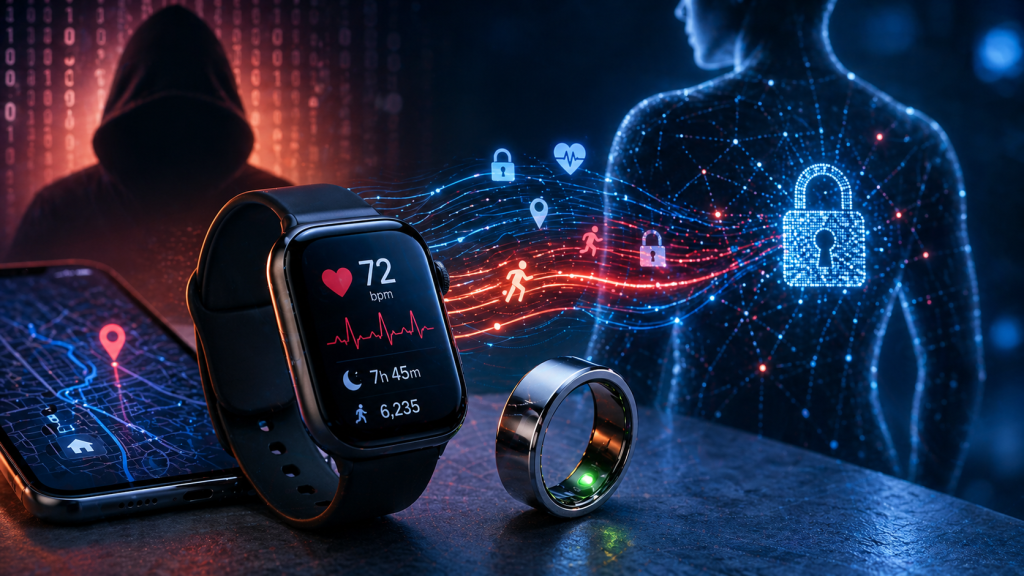
A watch that tracks your heart rate.
A ring that analyzes your sleep.
A bracelet that counts your steps and monitors stress levels.
Wearable devices have evolved from niche gadgets into an everyday part of life for millions of people – including employees across nearly every industry. But behind the convenience and sleek user experience lies a question most people rarely stop to ask:
Where exactly is all that data going?
Always Connected. Always Exposed.
Wearables don’t operate in isolation. They connect to smartphones, cloud platforms, third-party apps, and in some cases, even medical or corporate systems. Every one of those connections creates a potential attack surface.
And in many cases, cybercriminals don’t even need to compromise the device itself. Gaining access to the companion app, user account, or backend server is often enough to expose highly sensitive personal information.
The data these devices collect is far more revealing than most people realize. Location history, sleep patterns, heart rate fluctuations, and daily behavioral habits can expose when someone is home, when they’re under stress, and even when they may be emotionally or physically vulnerable.
For attackers, that’s valuable intelligence – ideal for targeted phishing campaigns, identity theft, fraud, and social engineering attacks.
When it comes to medical wearables – such as monitoring sensors or smart infusion pumps, the risks extend beyond privacy concerns and into real-world physical safety.
📊 According to IDC, the wearable device market is expected to reach 644.5 million shipments by 2027, driven largely by smartwatches and smart audio devices continuously collecting biometric data around the clock.
(Source: IDC Worldwide Quarterly Wearable Device Tracker)
A Market Moving Faster Than Its Security
One of the biggest challenges in the wearable space is the growing gap between the speed of innovation and the maturity of the security protecting these devices.
Manufacturers compete aggressively on design, price, features, and user experience – while security is too often treated as a secondary concern.
Default passwords remain unchanged. Software updates are inconsistent. Encryption is sometimes partial or poorly implemented. Excessive app permissions are still common across the market.
Meanwhile, consumers tend to assume that if a product is sold by a major brand or retailer, it has already been properly secured.
That assumption can be dangerously misleading, especially inside corporate environments.
Security Is a Shared Responsibility
Addressing these risks requires accountability from both manufacturers and users.
Device makers must adopt Security by Design principles, integrating security into the earliest stages of development instead of treating it as an afterthought.
Users – particularly in enterprise environments, need to develop stronger security awareness: reviewing app permissions, keeping devices and applications updated, enabling multi-factor authentication, and choosing vendors that demonstrate transparency around privacy and data protection.
The Enterprise Risk Most Organizations Overlook
Inside organizations, the challenge becomes even more complex.
Wearables, IoT sensors, and connected personal devices increasingly enter corporate environments carrying risks that often go unmanaged: excessive permissions, hard-to-monitor connections, shadow data flows, and exposure points outside traditional security controls.
Organizations that want to embrace connected technologies without increasing their attack surface must proactively map risks, audit device permissions, define clear security policies, and educate employees accordingly.
In a world where technology is literally attached to our bodies, cybersecurity is no longer just an IT concern – it’s part of an organization’s overall digital resilience.
When was the last time you checked the permissions your wearable apps actually have?
If your answer is “I’m not sure” – it may be time for a closer look.
📩 Reach out to our team for an initial consultation.