Cybersecurity teams invest enormous effort in protecting what happens inside the organization: networks, endpoints, identities, cloud environments and business-critical systems. But attackers do not begin from the inside.
They begin by looking at the organization from the outside.
Long before the first login attempt, phishing email or exploitation attempt, valuable information may already be publicly accessible, exposed, leaked or circulating across external environments.
A forgotten subdomain.
An internet-facing management interface.
An exposed service.
Credentials associated with an employee.
A reference to the organization in an external forum or marketplace.
Individually, each of these may appear to be a small signal.
Together, they begin to form a picture.
And that picture may be very similar to the one an attacker sees.
The attack surface extends far beyond the corporate network
Modern organizations operate across an increasingly distributed digital environment.
Cloud services, domains and subdomains, remote access systems, employees, suppliers, SaaS platforms and third-party services continuously expand the organization’s external footprint.
At the same time, infrastructure changes quickly.
Projects are launched and closed. Systems are migrated. Employees change roles. New services are deployed. Old assets are sometimes forgotten.
The result is a simple but important challenge:
An organization may not always have a complete view of everything that is visible from the outside.
And visibility matters.
Because attackers are constantly collecting exactly this kind of information to understand where potential opportunities may exist.
From scattered signals to a meaningful exposure picture
The problem today is rarely a lack of data.
Security teams already work with multiple platforms, dashboards, alerts and intelligence sources.
The harder question is:
Which external signals are actually relevant to our organization?
An exposed service is more meaningful when it can be connected to a specific asset.
Leaked credentials become more important when they can be associated with an organizational identity.
An external mention becomes more actionable when it can be correlated with the organization’s environment.
Without context, these are simply separate findings.
With context, they become exposure intelligence.
Introducing TREXION
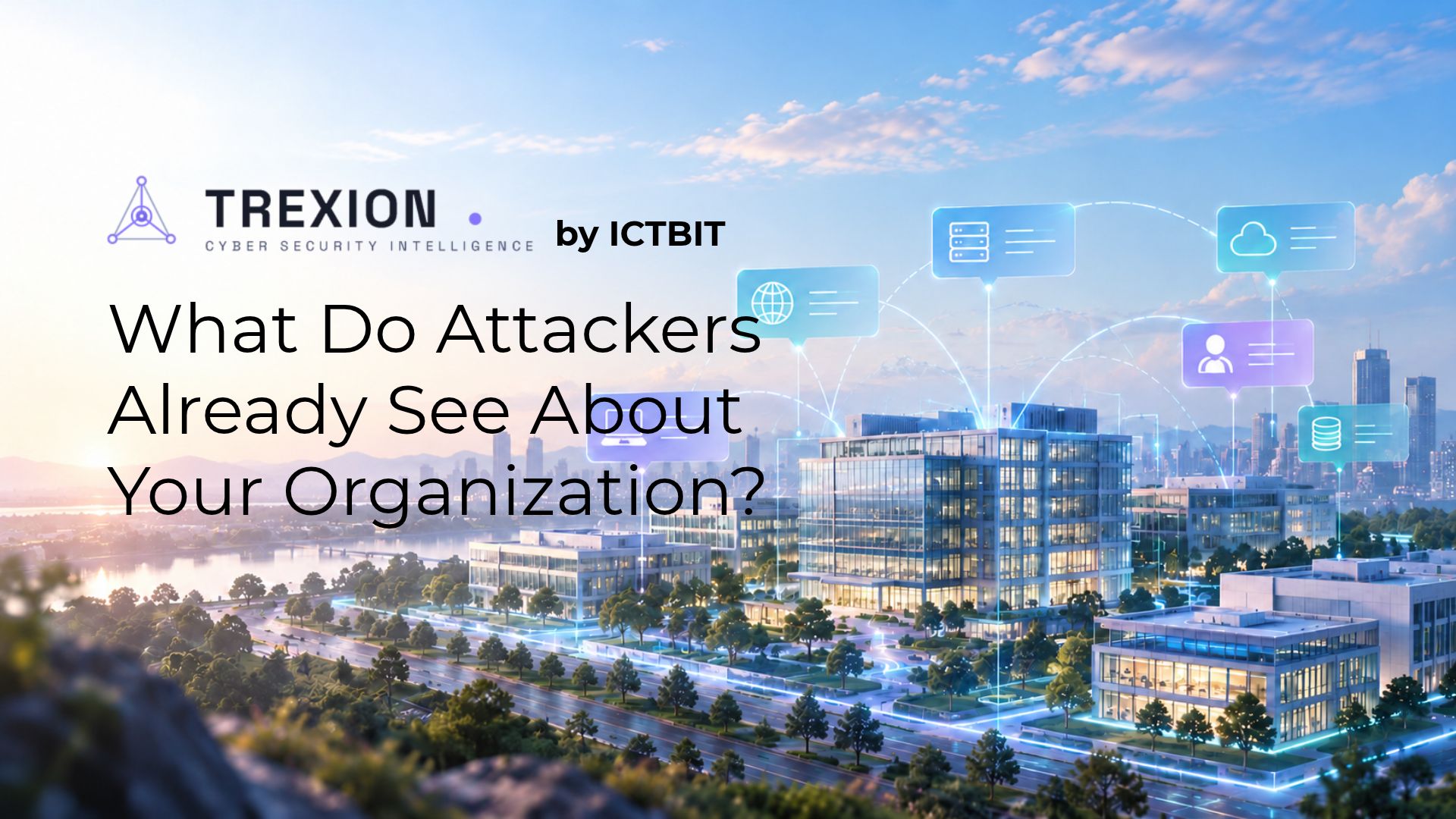
TREXION is an External Exposure Intelligence platform developed by ICTBIT to help organizations understand how they appear from the outside.
The platform brings together external intelligence and correlates it with the organization’s assets, identities and relevant third-party exposure.
Instead of looking at isolated pieces of information, TREXION is designed to help security teams build a clearer and more focused view of their external exposure.
This includes areas such as:
- Internet-facing assets and services
- Domains and subdomains
- Exposed management interfaces
- Credentials and identity-related exposure
- External references and relevant intelligence
- Third-party and supply-chain exposure
The objective is not simply to collect more information.
It is to understand what is exposed, what matters most and where attention should be focused first.
One platform. One external view.
External exposure is dynamic.
A view that was accurate last month may no longer reflect what exists today.
That is why effective exposure intelligence needs to be continuous – collecting, correlating and updating information as the organization’s digital footprint changes.
TREXION brings those signals together to support three essential capabilities:
Early identification
Discovering external exposure before it develops into a larger security issue.
Information correlation
Connecting findings to organizational assets, identities and context.
Risk prioritization
Helping teams distinguish meaningful exposure from background noise and focus on what deserves attention first.
Seeing the organization the way an attacker might
Traditional cybersecurity controls remain essential.
But protecting the organization also requires an external point of view.
Because the first stage of an attack often begins before the attacker ever interacts directly with the corporate network.
It begins with research.
With discovery.
With understanding what is already visible.
The better an organization understands that external picture, the better positioned it is to reduce unnecessary exposure and act before someone else does.
TREXION: See your exposure before attackers do.
Developed by ICTBIT.