When Cyberattacks Target Hospitals: How Sheba Medical Center and ICTBIT Built a New Standard for Healthcare Security
A joint initiative between Sheba Medical Center and ICTBIT is redefining how hospitals protect critical systems-without disrupting patient care.
The Hidden Frontline of Modern Hospitals
Late at night, when the corridors of Sheba Medical Center grow quieter, another frontline remains fully active behind the scenes.
Not doctors.
Not nurses.
But servers, networks, and critical systems that keep Israel’s largest hospital running 24/7.
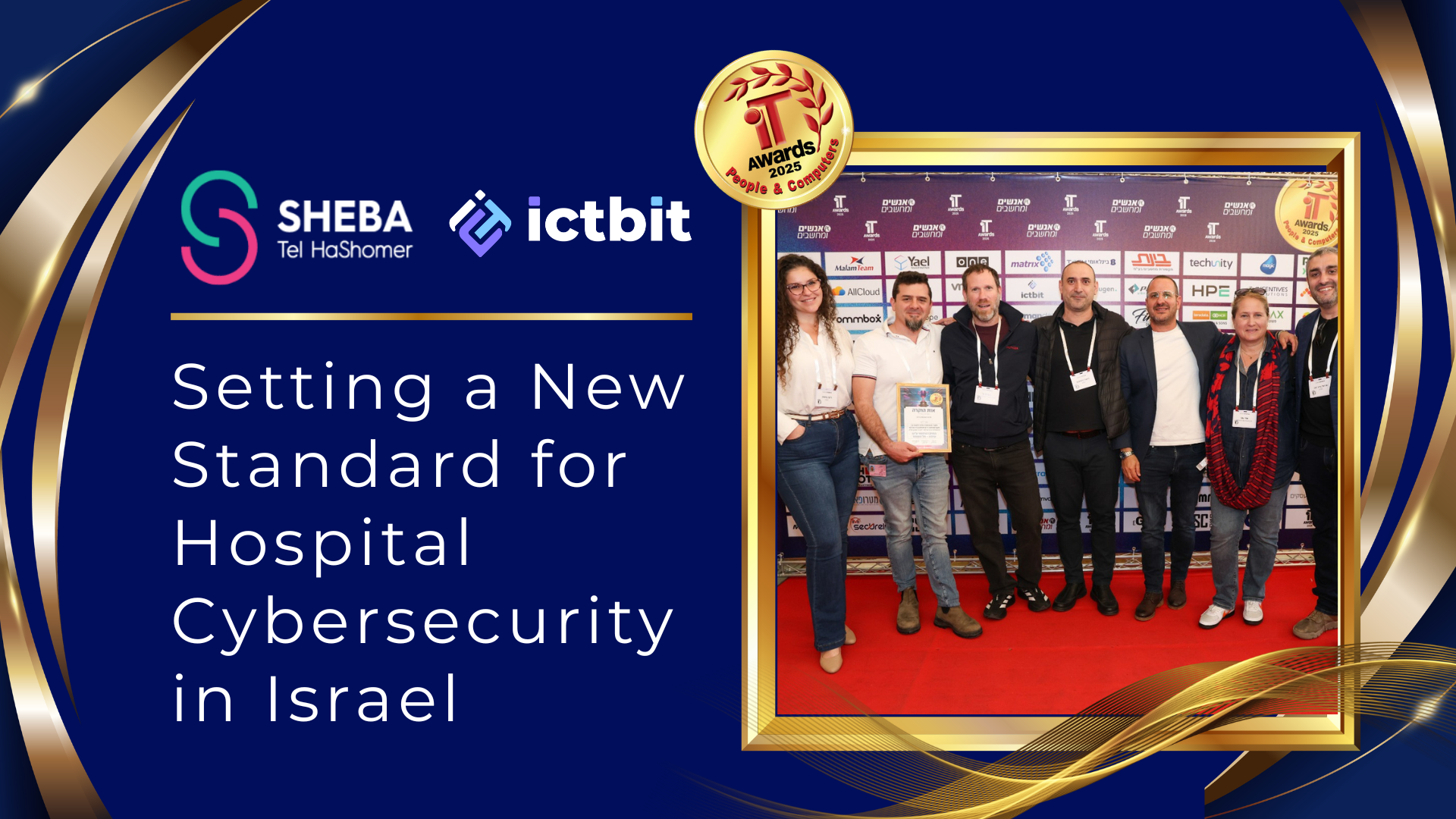
In that invisible arena, one of the most significant cybersecurity initiatives ever implemented in Israel’s healthcare system took shape: a large-scale micro-segmentation project led by Sheba Medical Center in collaboration with ICTBIT. The project recently received national recognition, winning the IT Awards 2025 for Cybersecurity and Information Security presented by People & Computers.
But the award is only part of the story.
Behind it lies a complex effort to protect one of the country’s most critical institutions at a time when cyber threats have become inseparable from national security.
When Cybersecurity Becomes a Matter of Patient Safety
Throughout the war, Israeli organizations experienced a dramatic increase in cyber threats. Healthcare institutions quickly emerged as particularly sensitive targets.
Hospitals today are among the most digitally connected environments in existence. From imaging systems and patient monitoring devices to clinical databases and operational platforms, thousands of interconnected systems must function simultaneously and continuously.
A disruption in any part of that ecosystem can have immediate consequences.
As Roy Feigel, CISO of Sheba Medical Center, explains:
“Cybersecurity in a hospital is not just about protecting data. It’s about protecting human lives.
If systems like CT scanners or patient monitors are disrupted by a cyberattack, our ability to provide care is immediately affected.”
This reality reframed the entire security discussion.
The goal was no longer simply preventing intrusions. The new challenge was ensuring that even if an attacker managed to enter the network, they would be unable to move laterally or reach critical systems.
A Wake-Up Call for Healthcare Infrastructure
For Lior Cohen, Head of Operations and IT Infrastructure at Sheba, the realization came with a clear shift in perspective.
Hospitals, he explains, are no longer viewed merely as healthcare providers – they are now part of a nation’s critical infrastructure.
Cyber incidents affecting medical institutions around the world reinforced that understanding.
The question facing Sheba’s leadership and technology teams became clear:
How do you build a security architecture capable of isolating threats inside a live hospital environment – without disrupting clinical operations?
Because unlike most organizations, hospitals do not have the luxury of maintenance windows.
Everything must work.
All the time.
“Like Replacing an Engine Mid-Flight”
The complexity of the challenge is captured in a comparison Feigel often uses when describing the project.
“It’s like replacing the engine of an airplane while it’s still flying.”
That analogy reflects the operational reality of modern healthcare systems.
Thousands of systems and devices operate simultaneously across clinical departments, laboratories, imaging centers, research units, and administrative networks.
Any security architecture introduced into such an environment must work seamlessly alongside existing systems without interrupting medical workflows.
This was the core challenge facing the joint team from Sheba and ICTBIT.
Designing Security That Stops the Attacker – Even After Entry
To address the challenge, the project implemented a Zero Trust security architecture combined with micro-segmentation, designed to prevent lateral movement inside the network.
Rather than relying solely on perimeter defenses, the architecture ensures that every workload, server, and system is protected individually.
Even if an attacker manages to penetrate the network, their ability to move across systems is restricted and contained.
The solution was built using:
VMware NSX, enabling granular micro-segmentation and security policy enforcement at the virtual machine level
Albarius, providing AI-based communication mapping and behavioral analysis that helped automatically identify application dependencies and network flows
Together, these technologies enabled the creation of precise security policies across thousands of systems operating in a fully active clinical environment.
Mapping a Living Hospital Network
One of the first stages of the project involved analyzing and mapping communication flows across Sheba’s extensive infrastructure.
Hospitals present unique challenges in this area.
Many medical devices communicate with specialized systems in ways that are not always fully documented. Some systems operate on legacy platforms, while others are integrated with modern cloud-based services.
Using Albarius’ AI-driven communication mapping capabilities, the team was able to identify real operational dependencies across the network.
This allowed ICTBIT and Sheba to build highly accurate segmentation policies without interrupting existing clinical processes.
The result was a dynamic security framework capable of adapting to the hospital’s complex digital environment.
A Partnership Built on Trust and Shared Responsibility
According to Rina Brumin, Head of Cloud Division at ICTBIT, the project’s success was rooted not only in technology but in collaboration.
“This was a true partnership,” she explains.
“The teams on both sides understood the responsibility involved. The goal was never simply to deploy a security solution – it was to ensure that critical medical systems remain protected without affecting patient care.”
Throughout the project, ICTBIT’s architects and engineers worked closely with Sheba’s IT and cybersecurity teams to design, test, and gradually deploy segmentation policies across the hospital infrastructure.
The implementation process was completed in less than eight months – without interrupting clinical operations.
From a Single Hospital to a National Model
Today, the project implemented at Sheba Medical Center is already serving as a reference model for additional government hospitals across Israel.
Beyond the technical achievement, the initiative represents a broader shift in how healthcare cybersecurity is approached.
Hospitals are increasingly recognized as strategic infrastructure whose digital resilience is inseparable from national resilience.
In this new reality, cybersecurity teams operate alongside clinical teams as part of the broader mission of protecting patient safety.
As Feigel summarizes:
“This project demonstrated that it’s possible to achieve the security standards of critical national infrastructure within a complex medical environment—without compromising the speed or quality of care.”
More Than a Cyber Project – A New Security Mindset
The recognition received through the IT Awards 2025 highlights not only technological innovation but also the growing importance of cybersecurity within healthcare systems.
For ICTBIT, the project represents a proud milestone.
It showcases what can be achieved when advanced security architecture, deep technical expertise, and strong collaboration between organizations come together around a shared mission.
Because in environments where every system supports life-saving work, cybersecurity is no longer just about protecting networks.
It is about protecting the ability to save lives.