Artificial Intelligence often feels magical.
With just a short prompt, you can generate art in Van Gogh’s style, bring old photos back to life, or create entire video scenes out of thin air.
Yet behind these wonders lies a single, elegant concept that is rapidly shaping the future of generative AI — Diffusion Models.
How Diffusion Models Differ from Other AI Systems
Unlike GANs (Generative Adversarial Networks), which can be unstable to train, or auto-regressive models that generate data one token at a time, diffusion models use a fundamentally different approach.
They start from pure noise and progressively refine it — step by step — until a coherent image or signal emerges.
This makes them remarkably stable, flexible, and reliable, even for complex generative tasks.
While GANs often “fight” between two neural networks, and auto-regressive models can become rigid or repetitive, diffusion models maintain balance.
The result? Outputs that feel natural, diverse, and refreshingly original.
Why Diffusion Models Never Generate the Same Image Twice
Every diffusion process begins with randomness — a completely noisy input sampled from a normal distribution.
Because this initial noise is always different, no two generations are identical.
This property gives diffusion models their creative power and uniqueness, producing results that feel organic rather than templated.
For designers, researchers, and IT innovators, this means infinite variation and adaptability — each output a fresh expression rather than a replica.
The Role of Compression – and Why It’s Essential
Diffusion models are powerful, but their magic depends on efficient compression.
Before the model learns to denoise, data is often transformed into a latent space through a Variational Autoencoder (VAE).
This step compresses complex visual information into a compact, structured form that the model can handle.
By operating in this compressed latent space, diffusion models achieve faster training, lower computational costs, and higher-quality results.
In short — compression makes creativity scalable.
Why the Denoising Process Must Happen Step by Step
Visualizing the journey from noise to meaning:
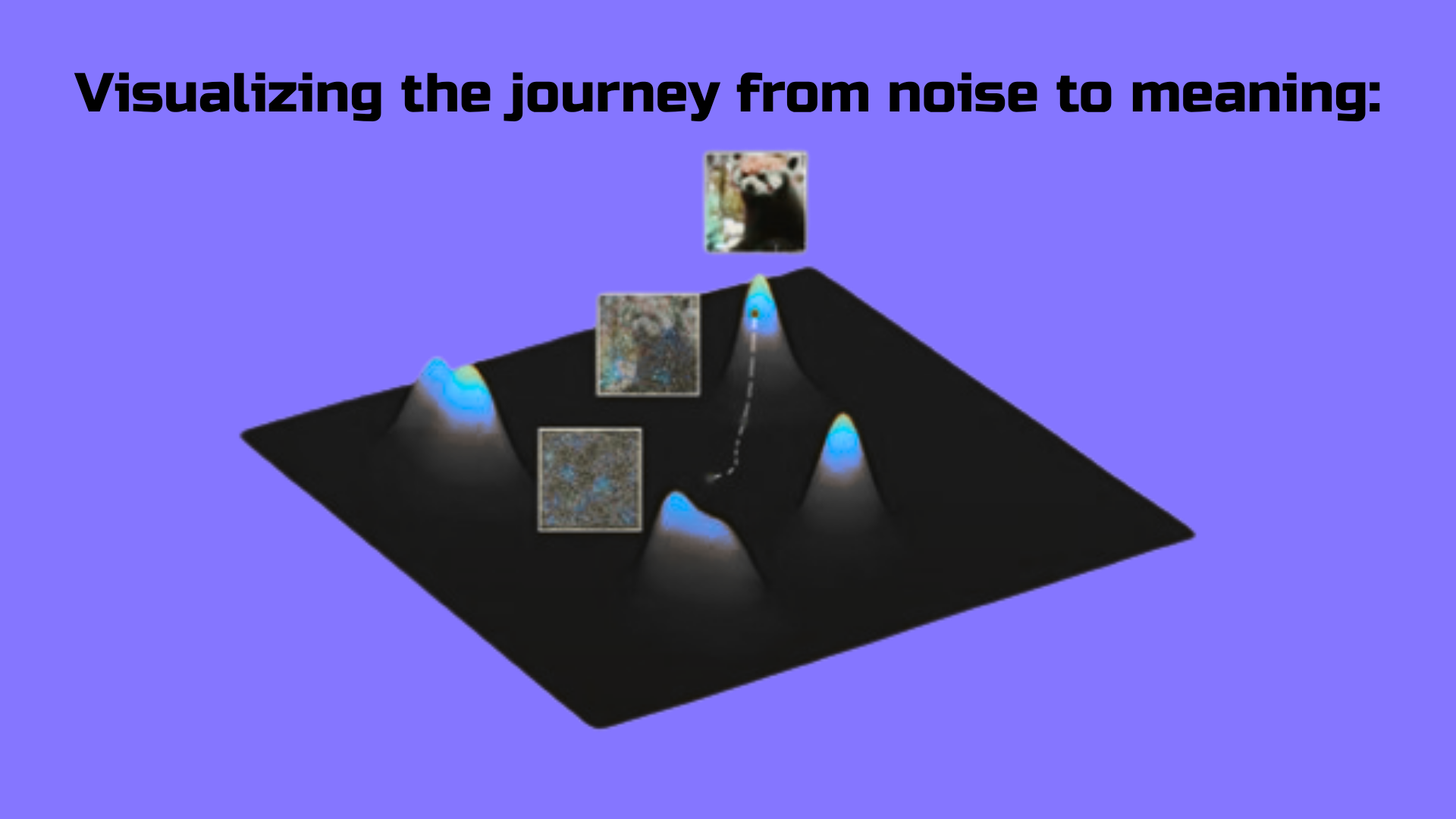
Starting out with random noise, slowly finding our way back home. We sample random noise from the normal distribution and slowly denoise our way to our desired representation. credit: Depth First, Youtube.
The model does not leap from static to a final image in one jump; it proceeds through many micro-steps, each removing a bit of noise and adding structure. This gradual refinement is exactly what makes diffusion predictable, stable, and visually coherent.
Further clarifying the forward (adding noise) and reverse (denoising) paths:
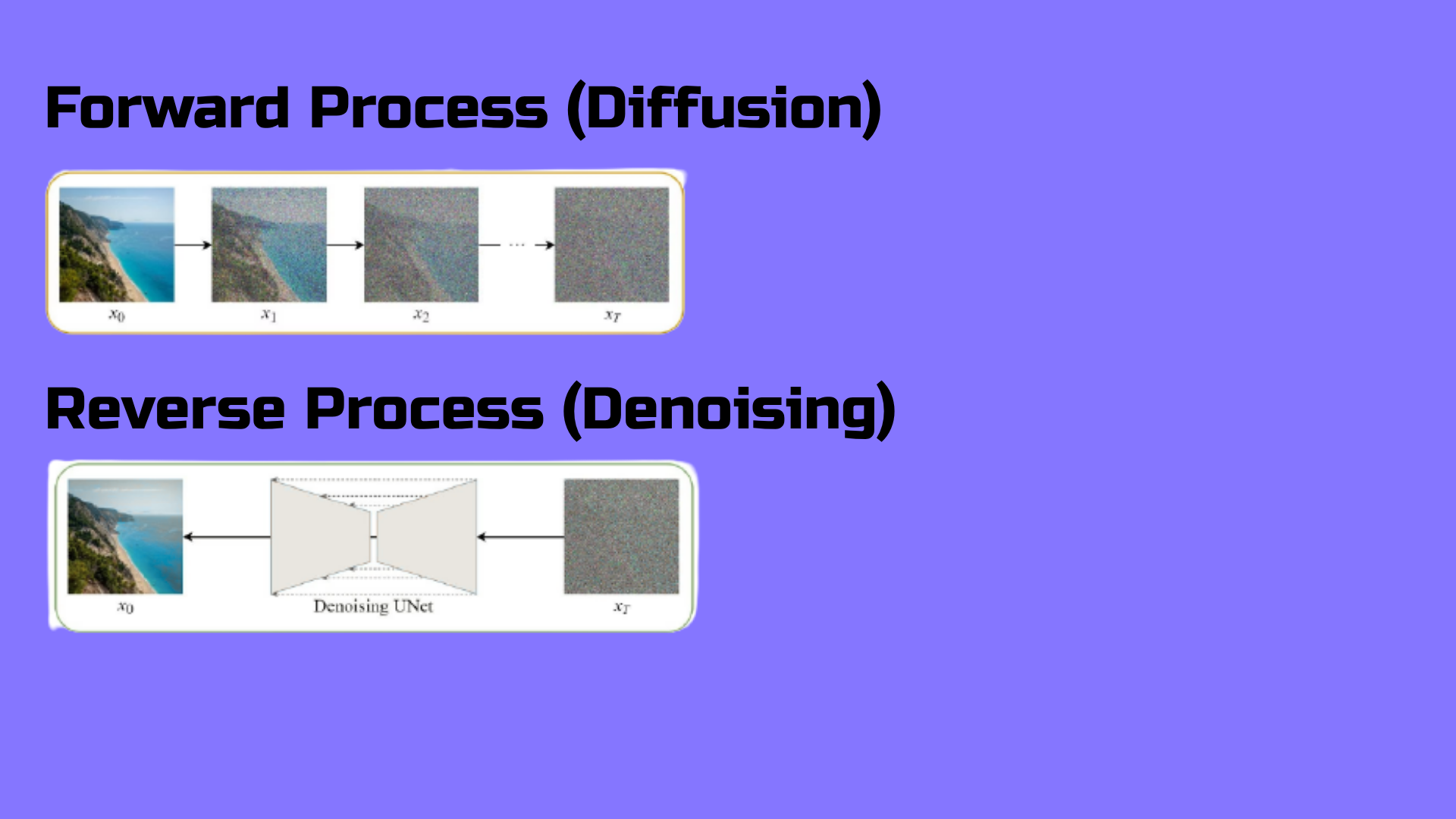
Diffusion training and inference process, we train the model to learn how to denoise our latent, “static” image in training and use the same model to infer our new image. credit: codoraven, Diffusion Model Clearly Explained.
Beyond Images – Expanding the Frontier
While diffusion is best known for image generation, its potential reaches far beyond visuals.
The same principles now apply to audio synthesis, voice generation, video creation, 3D modeling, and even molecular design in medicine.
Diffusion models are quickly becoming a foundation for AI-driven innovation across multiple domains.
For IT leaders, this means new opportunities for simulation, visualization, automation, and creative computing — powered by algorithms that understand how to turn randomness into order.
Final Thoughts
Diffusion models combine three essential ideas:
Randomness, to guarantee uniqueness; Compression, to make creativity efficient; and Step-by-step denoising, to refine complexity into clarity.
Together, these principles transform AI from mere computation into something that resembles imagination itself.
So the next time you see an AI-generated image that feels impossibly real, remember:
It all started with noise — and the patient, intelligent process of diffusion.